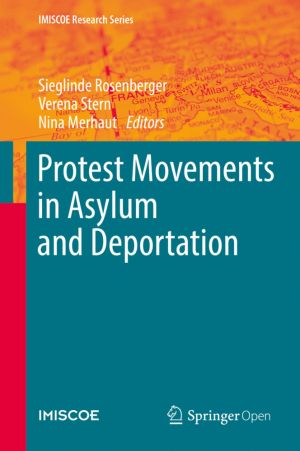
Protest Movements in Asylum and Deportation
by Sieglinde Rosenberger, Verena Stern, Nina Merhaut · History
About this book
This book deals with contestations "from below" of legal policies and implementation practices in asylum and deportation. Consequently, it covers three types of mobilization: solidarity protests against the deportation of refused asylum seekers, refugee activism campaigning for residence rights and inclusion, and restrictive protests against the reception of asylum seekers. By applying both a longitudinal analysis of protest events and a series of in-depth case studies in three immigration countries, this edited volume provides comparative insights into these three types of movement in Austria, Germany, and Switzerland over a time span of twenty-five years. Embedded in concepts of political change, limited state sovereignty, and migration control, the findings shed light on actors, repertoires, and the effects of protest activities. The contributions illustrate how local contexts, national political settings, issue specifics, and social ties lead to distinctly different forms of protest emergence, dynamics, and strategies. Additionally, they give a profound understanding of the mechanisms and constellations that contribute to protest success, both in terms of preventing deportations of individuals as well as changing policies. In sum, this book constitutes a major contribution to empirically informed theoretical reflections on collective contestation in the fields of refugee studies and social protest movements. This open book is licensed under a Creative Commons License (CC BY). You can download Protest Movements in Asylum and Deportation ebook for free in PDF format (5.0 MB).
Key Insights
- A 25-year longitudinal analysis reveals how 'bottom-up' mobilization directly challenges and shapes national deportation policies and state sovereignty.
- The divergence between solidarity-based activism and restrictive anti-asylum protests is driven by a complex interplay of local social ties and national political opportunity structures.
- Success in migration-related protest is not arbitrary; it depends on specific mechanisms of collective action and the tactical repertoires used to navigate migration control systems.
Related Books

Paths to the Emerging State in Asia and Africa
Keijiro Otsuka, Kaoru Sugihara

Taking the EU to Court
Christian Adam, Michael Bauer, Miriam Hartlapp, Emmanuelle Mathieu
Social and Economic Vulnerability of Roma People
Maria Manuela Mendes, Olga Magano, Stefánia Toma

Japan's Arduous Rejuvenation as a Global Power
Victor Teo
Sign in to leave a review and earn XP
Create AccountCommunity Reviews
No reviews yet. Be the first to review this book!