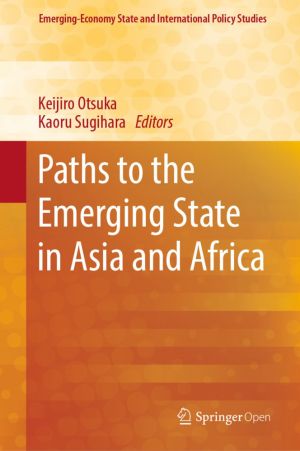
Paths to the Emerging State in Asia and Africa
by Keijiro Otsuka, Kaoru Sugihara · History
About this book
This book addresses the issue of how a country, which was incorporated into the world economy as a periphery, could make a transition to the emerging state, capable of undertaking the task of economic development and industrialization. It offers historical and contemporary case studies of transition, as well as the international background under which such a transition was successfully made (or delayed), by combining the approaches of economic history and development economics. Its aim is to identify relevant historical contexts, that is, the 'initial conditions' and internal and external forces which governed the transition. It also aims to understand what current low-income developing countries require for their transition. Three economic driving forces for the transition are identified. They are: (1) labor-intensive industrialization, which offers ample employment opportunities for labor force; (2) international trade, which facilitates efficient international division of labor; and (3) agricultural development, which improves food security by increasing supply of staple foods. The book presents a bold account of each driver for the transition.Keijiro Otsuka is Professor of Economics, Kobe University and Kaoru Sugihara is Specially Appointed Professor of the Research Institute for Humanity and Nature. This open book is licensed under a Creative Commons License (CC BY-NC-ND). You can download Paths to the Emerging State in Asia and Africa ebook for free in PDF format (7.7 MB).
Key Insights
- The transition to an 'emerging state' hinges on the synergy between labor-intensive industrialization and agricultural stability to ensure inclusive growth and food security.
- Successful economic evolution is governed by a nation's 'initial conditions'—the specific intersection of historical context and internal/external market forces.
- International trade acts as a critical catalyst for peripheral economies, enabling efficient division of labor and the scaling of domestic industrial capabilities.
Related Books

Taking the EU to Court
Christian Adam, Michael Bauer, Miriam Hartlapp, Emmanuelle Mathieu
Social and Economic Vulnerability of Roma People
Maria Manuela Mendes, Olga Magano, Stefánia Toma

Protest Movements in Asylum and Deportation
Sieglinde Rosenberger, Verena Stern, Nina Merhaut

Japan's Arduous Rejuvenation as a Global Power
Victor Teo
Sign in to leave a review and earn XP
Create AccountCommunity Reviews
No reviews yet. Be the first to review this book!